
Long Beach Previous Residents Sources
The trail for previous residents changes by era and by question. Nassau assessment records give the present parcel identity and current owner-mailing clue. The County Clerk’s land records connect recorded owners through deeds. Long Beach directories can place a listed household at an address for a publication year, while newspapers, censuses, permits, maps, and probate records supply dates or context that a deed does not. No one source supplies every answer. Use the source closest to the date being tested, and preserve its limits along with the result.
| Source | Years it covers | Where held | What it shows |
|---|---|---|---|
| Nassau LRV and tax roll | Current and displayed prior assessment years | Nassau Land Records Viewer and city roll | Situs, SBL, owner-mailing field, values, taxes, sales, and deed book or page. |
| Nassau land index and deed books | Online cutoff not published; older records through Clerk channels | US Land Records, Room B-1, and Map Room | Grantor, grantee, recording date, legal description, SBL, and book or page. |
| Long Beach city directories | c.1899 or early 1900s to the 1960s; exact gaps unknown | Public Library and local collections | Address-to-occupant clues and, when printed, spouse or work information. |
| Federal and New York censuses | Public federal schedules under the 72-year rule; state 1915 and 1925 | Library, Archives, and census access routes | Household snapshot, ages, relationships, and residence evidence. |
| Sanborn and permit records | Verified map volume 1922, republished 1955; permits vary | Library of Congress and City Building Department | Structure, street setting, work, and address-timeline evidence. |
Note: An owner record, a directory listing, and a permit applicant each describe a different relationship to an address and should not be treated as interchangeable.
Long Beach Previous Residents Start With SBL
For a Long Beach address, capture the Nassau section, block, and lot, known as the SBL, before searching names. Also keep the situs address, current owner name, owner mailing address, deed book or Liber/Page, and legal description from the LRV or tax roll. The situs is the physical property location. The mailing address is where tax notices go, and it may be elsewhere. The legal description and SBL are the stronger bridge when street labels, mailing addresses, or old instrument wording do not match.
The LRV accepts SBL and address routes, and its address guidance says not to include directional prefixes or street-type suffixes in the street field. A map search or GeoSearch can help when text search fails. The system warns that assessment and Clerk SBL formats may differ, so reconcile a useful parcel result with the County Clerk record before relying on it for a deed search.
Long Beach Deed-Index Cutoff Myth
The official Nassau US Land Records route is the online starting point, but the County Clerk’s public pages do not state an exact historical cutoff. Research also encountered redirect behavior that prevented a full live field inventory. That is an access limit, not evidence that older deeds do not exist. For older land books or a portal failure, the documented channels are the Clerk’s public facilities, Room B-1 and the Map Room, plus requests by mail, delivery, lobby drop box, or in person.
The Nassau County Clerk is at 240 Old Country Road in Mineola and lists regular Monday through Friday hours of 9:00 a.m. to 4:30 p.m., excluding holidays. Staff do not provide ownership information by phone or email. A certified deed request requires the SBL and is stated as $10, including a $5 search fee. Verify current charges before making a request, and ask the Clerk when a map-room search is needed for an older lot description.
The County Land Records page also links its guide and request paths. It is the proper place for originals and certified copies, while the library is the better route for directories and newspapers that identify past households.
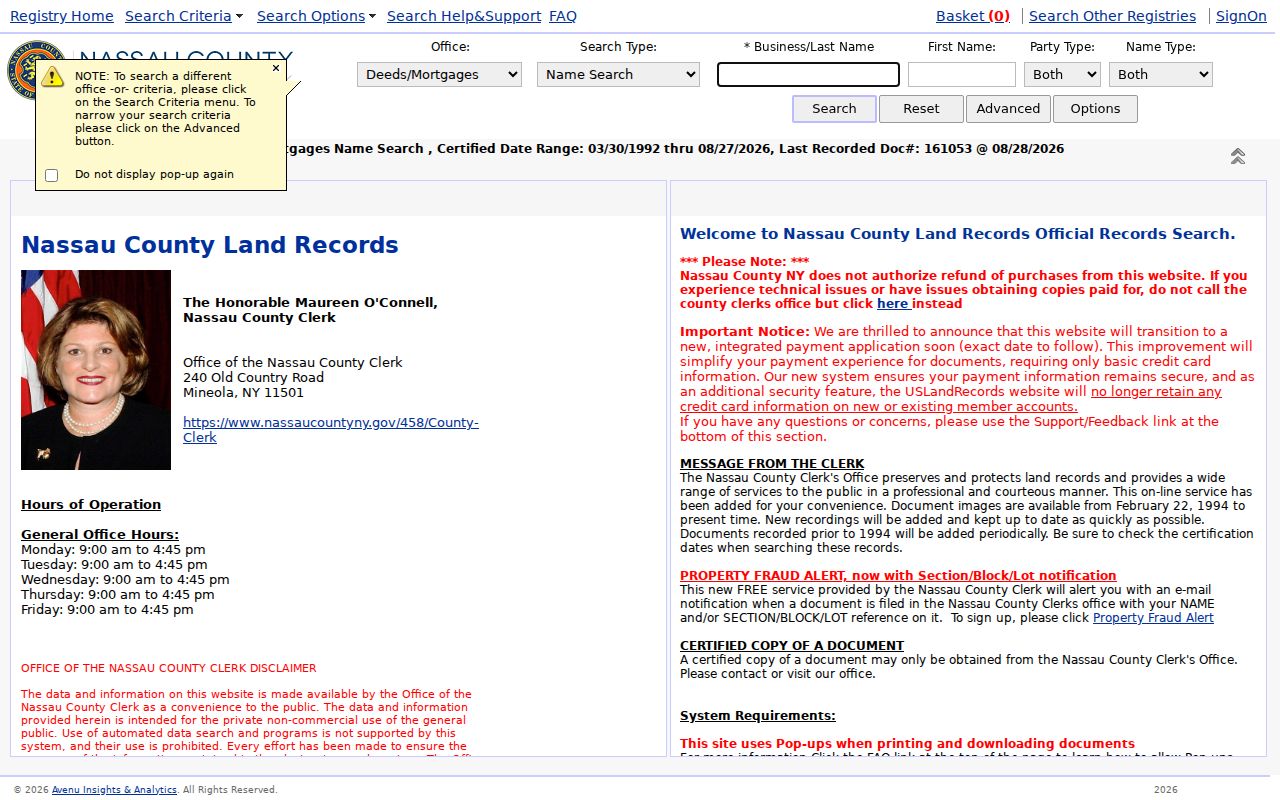
The online view is a useful entry route, but its unposted cutoff means the counter, Map Room, and request channels remain part of a complete previous-residents search.
Tracing Long Beach Previous Residents Through Deeds
Build the deed chain backward from the current owner, not from a surname guess. Locate that owner’s acquisition deed, identify the seller and buyer, then search the seller as a prior buyer to find the earlier acquisition. On each deed, record the parties, recording date, consideration or transfer information if visible, book or document number, SBL, legal description, and acknowledgment. Search by legal description and SBL beside the street address, because an older instrument may omit the present address or use a different form.
- Find the current parcel in the LRV or tax roll and copy the SBL, legal description, deed reference, and situs address.
- Use the County Clerk’s land-record route to locate the current owner’s purchase deed, or use the public counter when the online route does not reach it.
- Record the deed’s grantor, who transferred the interest, and grantee, who received it.
- Search that earlier owner as a grantee to locate the deed by which the owner acquired the parcel.
- Repeat backward, checking the SBL and legal description at each transfer and moving to the Map Room or Clerk channels as the web route ends.
- Grantor
- The party transferring a recorded property interest.
- Grantee
- The party receiving that recorded interest.
- Chain of title
- The sequence of recorded transfers used to trace ownership of one parcel.
- Legal description
- The lot or parcel wording in the instrument, often more durable than a street address.
Deeds can show an ownership trail, not a list of everyone in a household. For a current street-level parcel path, use the Long Beach by-street directory after the historical chain is established.
Long Beach Previous Residents in Directories
Once a deed establishes a period, move to the directory shelf for household-level clues. Search the exact street and number in a reverse or criss-cross section when the volume has one, then search the surname in the alphabetical section. Keep the edition year and page, and compare adjacent years. The Long Beach collection is described as c.1899 or early 1900s through the 1960s, with publisher sequence and gaps still to be verified. That uncertainty should be preserved in any house history.
A directory may list an address, spouse, profession, or work location. Those details help sort same-name people but do not prove current residence or every member of a household. The Long Beach city directories collection explains the library and archive routes for obtaining the historical volumes without substituting them for a deed record.
Pair each confirmed directory year with the nearest available census. Federal schedules generally open after 72 years. New York’s 1915 and 1925 censuses survive as Archives series A0275 and A0276, though they are not comprehensively indexed. A 1920s street number should also be tested against a map, legal description, and cross street before it is treated as today’s parcel.
Long Beach Previous Residents Sanborn Check
The verified Long Beach Sanborn volume is dated 1922 and was republished in 1955. Its 36 sheets cover Long Beach and nearby Atlantic Beach, East Atlantic Beach, Lido, Point Lookout, part of Hempstead, and Island Park. The map can show a building footprint, street arrangement, lot relationship, use, construction materials, and fire-risk notation for its date. It cannot identify an occupant. That distinction makes it a strong check on the physical setting of an old directory address, rather than a people record.
The Library of Congress Sanborn map route is the free source for the verified volume. Use the street index, inspect additional place names and notes, then compare the sheet with the present GIS parcel. A building appearing on the map verifies neither an owner nor a move-in date.
Long Beach Previous Residents Address Checks
Address continuity is the trap in a barrier-island history. Beach, canal, walk, West End, East End, and adjacent-community labels may appear inconsistently in older records. No verified Long Beach renumbering or street-renaming year was located. When a result looks wrong, test the current SBL, historic map, cross street, city directory wording, deed legal description, and postal city together. Mark any bridge between two address forms as an inference until the records support it.
The city code’s 1911 Map of Estates of Long Beach and 1923 West End map are useful historical anchors. They can connect an early subdivision or lot description to a modern parcel search. They are better evidence than assuming that a familiar neighborhood label is a legal city, postal city, or deed description.
Long Beach’s WebLink permit route is a second address-history channel for permits and certificates of occupancy. The research did not capture its live field labels. When a record is not indexed, ask Building Department staff for an address search or submit a FOIL request with the address, approximate years, and record type. A permit date can date work on a building, but it is not by itself a move-in or sale date.
Long Beach Previous Residents Trail Endpoints
Close an older household trail with a newspaper or probate record when the facts point there. The Long Beach Public Library and New York State Library catalog provide a path to Long Beach Life microfilm, listed for 1928 through 1954. A death notice may identify relatives, a residence, or civic ties. Nassau Surrogate’s Court can add an estate path, with online Nassau web links generally available for documents filed on or after February 19, 2014 and earlier materials at the public computer. Restricted fields remain restricted.
The county’s free Property Fraud Alert is a separate safeguard for recorded-property monitoring. It is not a source for previous residents, but it can alert a person to a new recording tied to a person or business name and or town and SBL.
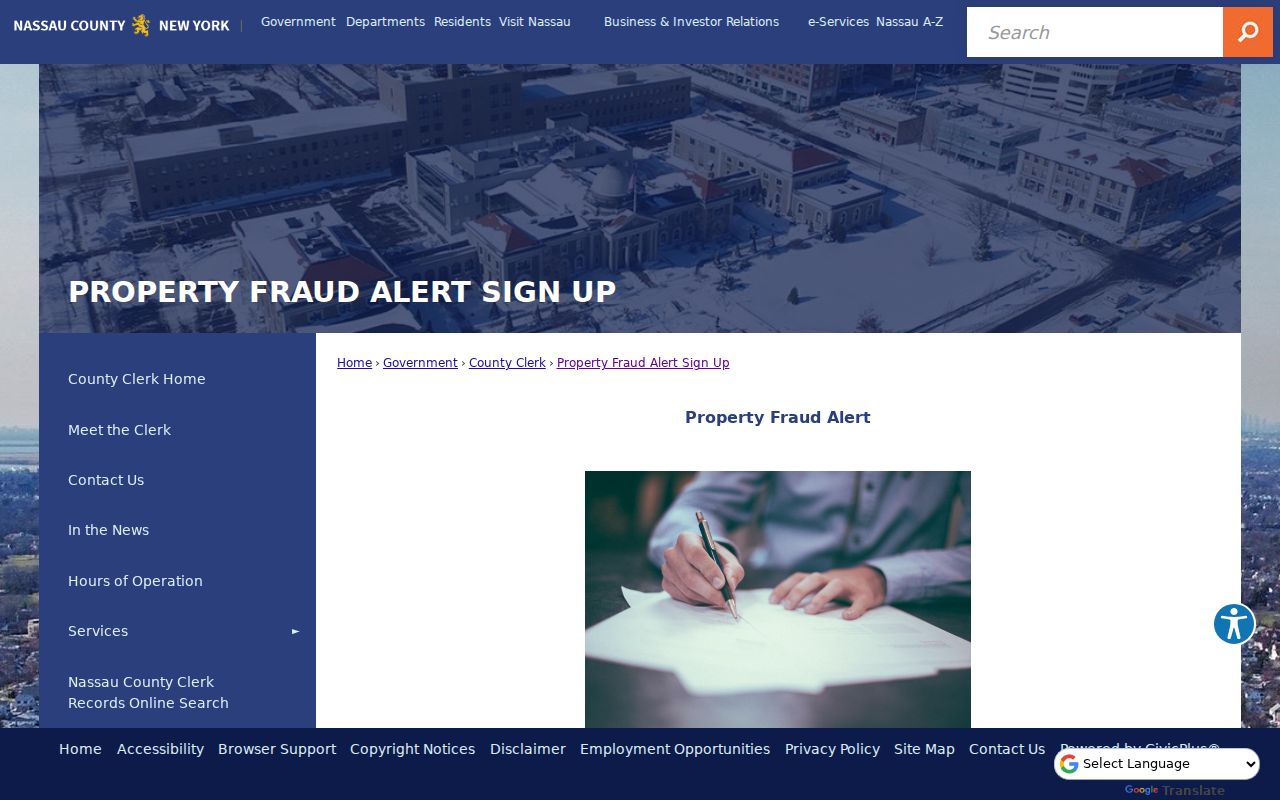
The alert page belongs at the end of the deed process because it watches later recordings, while the Clerk, library, and archives provide the documented routes for reconstructing older address history.